Friday, 20 December 2013

Images for a gallery


I have decided that these are the images I'd like to include in a gallery setting. I think they best represent the room and Salford Lads Club. My original images were about documenting the room and the reasons it was there, the setting of it all and in general the club. In a gallery I think people would be more interested about some of the things in the room, all the little trinkets represent a visit from a fan who each have their own connection with the band. I feel the above photos are a good representation of the room.

The wide shot lets people appreciate the sheer size of the room and gives an insight into what's inside without giving too much away. The close up shots then show post it notes with scribbles on both which happen to be from American visitors. Again this re affirms the importance of the room if international fans are willing to travel.

I think these 3 photographs give enough insight into the room for an audience to grasp an understanding and could maybe spark a potential interest in seeing more. The whole room is like a time capsule and each note on the wall represents someone and their life.

I don't think I would frame the images, I think they would be best suited on a large canvas style print. Especially the shot of the room, this would benefit from being quite large so you could see the details. I would place the images horizontally so the audience would view them from left to right like a book. This would ensure they had an idea that the end photographs came from the room pictured in the first.  


Saturday, 14 December 2013

Sean Smith Review


Recently I've been to view the exhibition at Imperial War Museum North, based around Sean Smith and his work in Iraq. The exhibition was to mark 10 years since the start of the war in Iraq. Smith spent a lot of time in Iraq over the years working as a photojournalist for The Guardian so a lot of his work was shot for publication, however there were several parts that were more social documentary. He was approached by IWMN and asked to select a series of images to mark the 10 years and so he did.

He was shooting at a time when it was heavily featured in the media, several of the shots show events and scenes that would have never made it into The Guardian. They would send out the wrong message. Linking to Fred Ritchin's book, photojournalism these days is a tool used to portray a message. Photographs can be crafted in a similar way to words to help persuade for an idea or argument.

The images featured in this exhibition are quite interesting, he portrayed every possible side to the conflict. The soldiers who were 'fighting' for the cause, the locals affected and everyone else involved. We see a side to things that was less reported in the British media. Some of the shots are gruesome, some are comical and some are shocking. This is a nice reflection on the real world, I feel as though there was little censorship in his work and it's apparent that as a photographer Smith isn't afraid to get amongst it all. The addition of text on the walls was a nice touch, it helped link the photojournalism aspect to the documentary feel of some of the photographs.

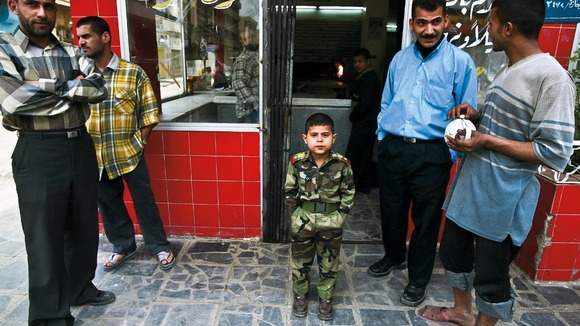
One of the more striking images for me is the young boy holding the rabbit. To find something as pristine as a fully white rabbit in a war zone just seems crazy. The child in the photograph seems to be innocent, it's a small window into what a real childhood should be like. Instead the child is growing up amongst one of the most dangerous conflicts after WWII. I imagine it was a hard task for Smith to stay so impartial, of course he's there to document the war but he's paid by the British. The Guardian are obviously wanting photographs that show American & British troops in a positive light in order to justify our involvement in the war.


The photographs chosen for the exhibition feel very real. It's a small window into the chaos of warfare from every angle. As the general public we can't imagine the horrors the people involved are seeing but this exhibition is as close as we can get, it brings up a range of emotions using a limited number of images which is a hard thing to do. As a society we are quite hardened to disturbing images, we hear about death everyday on the news but to see it so apparent in a war lasting so long is even more disturbing. Media coverage died off at several points throughout the war but it's apparent from Smiths photographs that it never got any easier. He's made a great job of taking a photojournalism project into a documentary project and making a connection between the subjects and the audience.

It's strange to see the community in Iraq and the way they live their lives amongst the chaos of military rule. After 10 years of being heavily involved with the military it is clear that relations between the Iraq public and military were improved. The soldiers were there to offer protection alongside humanitarian aid and in the photographs it's clear it was an uphill struggle for the army to gain the trust and support of the locals.

Friday, 13 December 2013

Final Images

'Salford Lads Club - Exterior, where the Smiths Stood'
'Salford Lads Club - Court Area'
'Salford Lads Club - Boxing Gym'
'Salford Lads Club - Leslie Holmes outside The Smiths Room'

'Salford Lads Club - Dallas, TX'
'Salford Lads Club - Bucket List'
'Salford Lads Club - The Smiths Room'
Salford Lads Club - The Original Story'


'Salford Lads Club - 'The Queen Is Dead' Cover'

'Salford Lads Club - The Tambourine'


Wednesday, 11 December 2013

Photojournalism

photojournalism
fəʊtəʊˈdʒəːn(ə)lɪz(ə)m/
noun
  1. 1.
    the practice of communicating news by photographs, especially in magazines.


Photojournalism has been around since the 1890s, it pre-dates 35mm photography. The real boom for it was with the development of 35mm SLR cameras.The 'Golden age' is said to date from 1930-1960 when there was a lot happening in the news.

At this time photojournalists were relied upon to provide images to tell stories that words alone couldn't. If it was photographed and reported as news there was little question to it's authenticity and it was taken as 100% truth. With the invention of small 35mm bodies it was easier for photographers to leave the studio and connect with the people. For the first time it was easy to document what was happening in the world and so people began doing just that. 

Some of the most historic photographs of the 20th century were shot by photojournalists for major publications. The more notable publications of the time were Life, Sports Illustrated, Paris Match and Picture Pos. However, "when life magazine made the announcement in 1972 that it was ceasing its weekly publication, many people claimed that photojournalism was dead" (http://www.lightstalking.com/a-brief-history-of-photojournalism)

Traditional photojournalists still exist however with the boom of the internet and smart phones it's easier than ever for anyone to report news, the need for photojournalists is slowly decreasing. In May 2013 the Chicago Sun Times came under fire when it decided to terminate it's entire photography staff in favour of 'iPhonejournalism'. In an age where everyone has a camera in their pocket, can photojournalists compete in getting that money shot of that crucial new story?

There's a lot of talk recently about newspaper publications moving from print to online based media. Some have welcomed the move however some newspapers have insisted they will be charging a subscription fee for the online viewing. Will people pay for something they can get free elsewhere? We have paid for paper publications for years but one reason the internet is so popular is due to free information. Is this the end of newspaper publications and photojournalism?

Once French publication 'Liberation' decided to revolt and chose to remove all photography from one of it's November editions in a bid to support photographers. It's quite a striking publication that received a lot of media attention. This is a great way to highlight the importance of real photography in publications. It's an essential part of media which cannot be replaced by members of the public with smartphones.


 “A visual shock. For the first time in its history, Libération is published without photographs. In their place: a series of empty frames that create a form of silence; an uncomfortable one. It’s noticeable, information is missing, as if we had become a mute newspaper. [A newspaper] without sound, without this little internal music that accompanies sight,” writes Brigitte Ollier, a journalist Libération‘s Culture desk.

(http://www.bjp-online.com/2013/11/french-newspaper-removes-all-images-in-support-of-photographers/)


Tuesday, 10 December 2013

Feedback

After showing Les and my group the contact sheets from both my shoots and a quick edit of 15 or so images I was very happy to hear that they thought the images were strong. I'd chosen this story because of it's interest to me personally but also because I thought I could do it justice.

I think I have a strong set of images that tick the boxes for a news story. The only comments I received was that in some of the detail shots of the room there were hot spots on the walls from the reflection of the lights. This was somewhat unavoidable, short of turning all the lights off and going for long exposure or portable flash lighting, instead of going back and reshooting I've decided to try and select images where this isn't as distracting. In some of the images it's totally unavoidable but I don't think it is enough of a factor to reshoot the whole thing.

I've narrowed my images down to around 15, I was conscious to include images that would lend themselves to a written piece such as the photograph of the tambourine. Les has a nice story about how he acquired this and proof that it was signed so I thought this would be a nice shot to include because if it goes to a feature it would be a nice thing to talk about in an article. 


I've also chosen to include an original article about when Smiths fans first started coming to the club and the club was very much against it. They said fans were vandalising the club and causing issues. This is the back story for the motivation to open a dedicated room for fans and Les has been very welcoming and in 2004 decided to make the room open for public viewing and contributions. Again this is a key element for a news story so having a shot of the original article makes it more interesting. Rather than just reading about why the room exists people can see the original article. 

My struggle with this project was always going to be creating 10 interesting images based around 1 room. Cassie was very conscious of this and said my "Providing there is enough difference in the images it could lend itself to a feature" I've tried to keep this in mind from the start and take photographs that were both interesting and different. I'm very happy with my images and now it's time to narrow down my shots to 10 final images and caption them.

Monday, 9 December 2013

Photoshoot 2

On my return to Salford Lads club I conducted my second shoot, this time with much more focused aims and a shot list in my head. I had a good establishing shot of the room from my first visit and some nice detail shots. This visit was more about the rest of the club, I needed to get an exterior shot in a similar style to the original smiths photo. Without this the story would not have the key link to the smiths so this was essential.


Next up I wanted to illustrate how the room is like a time capsule. It remains heavily un modified from it's original use as a weights room however the rest of the club has undergone restoration and is very modern. The team who are running the club are all volunteers and they do a great job and this is evident in the care taken to maintain the club. 

I wanted a nice wide shot of the football court as this is where the Smiths room is located and Les asked if I could photograph the boxing room as this was another large part of the clubs history. My final essential shot was of Les outside the room. We've been told from day 1 that photojournalism works best when there is a human element to the story. People like to know about other people, that's how humans work. We read news to see what is happening to people around us as well as the wider world. Without including Les in my shots I don't think I could do the club justice, people need to be able to relate a face to the club. 


I'm very happy with the shots, it was a nice bright day which only helped things inside the club. There was a huge sunlight above the courts that let me get a great wide shot of the court. I managed to convince Les into posing outside the room for a quick 2-3 shots which I'm very happy about. I didn't want to put him under pressure so I was more than grateful that he agreed to be photographed.

From looking through some publications both before and during this project I've became familiar with the style of shots news bodies use. Interior shots tend to be on a wide lens from a corner of the room, usually with natural light. There are a few tricks I've been told to use and some to avoid, if someone is featured in the photograph, it's essential they are looking into the camera. It's no good having someone with their back to you. It's adding nothing to the image and is not showing a connection between the subject and the camera, which is what the audience will expect.

In my head I knew I had to shoot 10 images, I had a solid 4-5 images that I knew I wanted before I started:


  • Establishing shot of the club
  • A shot of the boxing room
  • A wide shot of the court
  • A shot of Les outside the room
  • Establishing shot of the Smiths room
  • Detail shots of the room


I wanted them to be viewed in that order because I felt they would tell the story better. You're introduced to the club, you see the club as it stands today (very modern and fresh) and then you're introduced to a character (Les) outside a room with the door slightly ajar and the only clue is a small plaque that says 'Smiths Room'. This then leads on to an establishing wide shot of the room and this is where people may begin to understand the relation between the Smiths and the club. The rest of the shots are then detail shots inside the room.

I feel I have all the shots needed for this project, I set out with a shot list in my head and I've got all the shots I need. I have the opportunity to revisit the club if I find I've missed a shot or something else crops up however it's now time to start editing down my shots into the final 10 images for Quays News.

Thursday, 5 December 2013

Feedback Sessions

We've been having weekly feedback sessions where a few of us get together with Les and talk through our progress, show any images we've taken and just generally talk and issues out. These have been really helpful but for the first few sessions I was in limbo with my ideas waiting for responses, trying to find contact details and just generally not hearing back from anybody.

This was slightly disheartening and I was considering a full rethink of my idea. Luckily I then heard back from Salford Lads Club and they were happy to let me come down.

I talked my idea through with Les but we were unsure if Salford Lads Club qualified as 'Hidden Salford' because it was so well known but then I mentioned the Smiths room and no one in the group had heard about it so it was left to me to decide if the idea was fitting enough. I spoke to Cassie at quays news and she was quite interested in the story. She said that there had been a few pieces on the club in the past but nothing on the Smiths room. So if I was to focus mainly on the room the story would work.

Next it was time to decide how to approach it. We've been talking a lot about how to approach people as a photojournalist. How you do this affects your final shots in my opinion, you need to make your subject comfortable around you before you pull out a camera, especially if it's a sensitive story. I decided to first go down to the club and meet the people involved and show them I had a genuine interest. So far I've been down and spent 2 hours meeting different people involved both old and young team members as well as youths who attend. It's been a really positive experience and they were happy to let me take some test shots and I've arranged to go back one day next week and conduct my shoot during the daytime.

I think a key element of this project was to connect with people, it was difficult at first because it's so hard to get a reply through emails because they're so easy to dismiss. I'd emailed SLC a number of times and heard nothing and finally decided to give them a call and 30 seconds into the call they invited me down, I think most people are happy to give a photographer there time as long as you make it benefit them. I offered to let them use any of my shots and also told them about the possible feature in Quays News which is good publicity for the club.

Monday, 2 December 2013

Photoshoot 1

I recently went down to visit Salford Lads Club and take a look at the Smiths room. It was a great experience and I managed to take some test shots and get a feel for the space.

After talking with Leslie, who basically curated the room he was unsure about me photographing inside the room. He didn't want to give too much away as they like to gets fans into the room on a regular basis and people do flock to see it purely because there's not a lot online about it. There is the odd wide photo but no real close ups of articles in the room. I liked this, it added to the mystery of it all and I had to respect his wishes. In the end he was more than happy for me to photograph the room freely but he mentioned a few items he didn't want any close ups of because of copyright issues or their uniqueness. He wanted to keep it fresh for new viewers and not spoil the surprise by having photos online of key elements.

I started by getting a few wide shots of the room but it was quite awkward. The walls are really busy but the floor is empty and it's an awkwardly long room. I tried a few shots from each corner until I was happy. Fortunately I'd packed a 10-20mm lens which allowed me to photograph the majority of the room and give a nice sense of size. Photojournalists often use wide lenses indoors as it gives a good idea of the entire space, especially if it's a large group shoot or a shot of a room.

I then moved onto detail shots, there was so much on the walls it was hard to take everything in. I selected a few things that caught my eye, mainly being post it notes created by fans who had traveled to see the room. It was great to see the diversity of the fans, there was someone from every country from Australia to Norway and everything in between.

I really wanted to capture the personal element of the room. It was clear from the second I entered it's a room made by fans, for fans. There's no ulterior motive, it's not there to make money. It's a collection of memorabilia to commemorate one of the most influential bands of the century.

I'm happy with my first visit, I've arranged to go back next week but during the day to get some natural light into the room as the lights were casting hot spots onto images on the wall in some shots.

My plan for the next shoot is to photograph the exterior of the club, which is an essential shot for a news story. I would also like to photograph elsewhere in the club and also grab a shot of Les outside the room as it's his passion and knowledge that made it possible!